" height="8px" id="x_HOY8XyM" transform="translate(6.008 4)" width="4.015649999999994px"/></svg>)
" height="7.5px" id="CSiwjDzLM" transform="translate(5 4)" width="6.570300102233887px"/></svg>)
" height="5.684156997170297px" id="FuNtYuhE0" transform="translate(4 5.16)" width="8px"/></svg>)
" height="8px" id="MlOPP20GY" transform="translate(4 4)" width="8px"/></svg>)

See how PetDesk can help build a refreshed brand strategy for your practice.
Last updated: December 1, 2025
When your practice’s branding “looks” right (from your website’s color palette to in-clinic signage) you’re communicating more than just professionalism—you’re sending cues about trust, care, comfort, and the kind of experience you deliver.
This is especially true in veterinary marketing: people seek a vet where their pets will feel safe, valued, and well-cared for.
Your clinic’s color scheme plays a key role in that impression. We’re covering how colors influence customer perceptions and behaviors, which palettes tend to work well in a veterinary context in 2025, and how PetDesk Marketing can help you enhance your branded presence to stand out from the competition and retain more clients.
What is color psychology? Why does it matter for veterinary practices?
Color psychology is the study of how hues, tones, and combinations influence human emotions and behaviors. Research in marketing shows that first impressions are heavily influenced by color: some studies find that up to 60-90% of snap judgments about a product or service are based on its visual presentation—of which color is a central component.¹
More than being decorative, that means your vet practice’s brand palette directly impacts:
Whether a pet owner feels your clinic is trustworthy and competent
How “warm” or “clinical” your brand comes across
How consistently clients remember and recognize your practice across touchpoints
A strong color strategy supports your broader marketing and brand strategy: building loyalty, attracting the right kind of client, and differentiating your clinic in a competitive local market.
The 2025 color palette: what works (and what to be cautious of!)
Here are common color associations for veterinary practices, how they translate in today’s design context, and misuses to avoid.
Blue: trust, calmness, reliability
✔️ What works: Blue remains one of the most widely used colors in healthcare and veterinary brands. It communicates stability, competence, and a sense of calm. A pet parent seeing a clean blue/design may feel: “I can relax, they’ll take care of my pet.”
👉 Modern application: Use a mid-to-deep blue as a primary hue for your website header, navigation, or core brand color; pair it with a soft accent color (such as a muted green or warm grey) for balance.
⚠️ Caution: Blue can also feel cold or impersonal if overused or paired with harsh whites; be sure to soften it with friendly imagery or warmer secondary accents.
Green: health, growth, nature
✔️ What works: Green ties into themes of well-being, natural health, and renewal. Many practices emphasizing wellness, holistic care, or sustainability use green to signal that orientation.
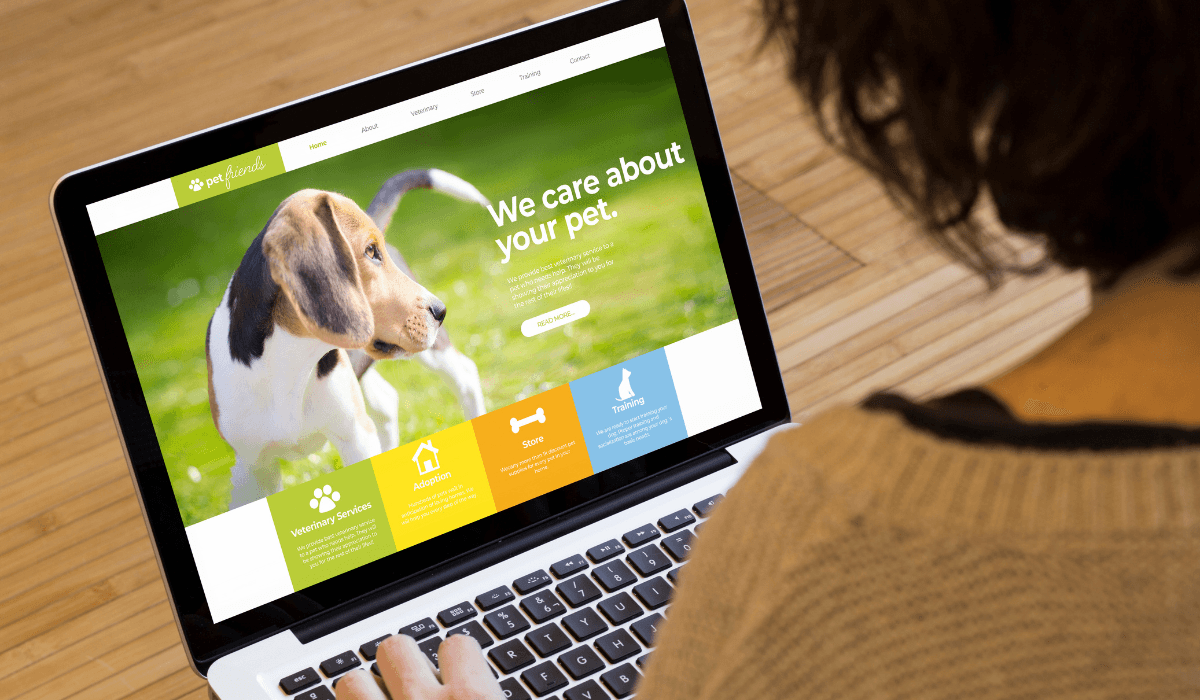
👉 Modern application: Use green for secondary elements like buttons (“Book Now”), iconography (wellness programs), or in photography overlays of pets + nature imagery.
⚠️ Caution: Some greens lean too “eco-biotech” or overly bright “medical-green.” Aim for a balanced, desaturated green rather than a neon shade.
Yellow & orange: warmth, approachability, joy
✔️ What works: Yellow conveys optimism, friendliness; orange conveys creativity, energetic warmth. These are useful for making your practice feel approachable, especially in client-facing materials.²
👉 Modern application: Use these as accent colors rather than primary palettes (e.g., appointment buttons, promotions, welcome banners).
⚠️ Caution: Too much yellow or orange can lead to visual fatigue or be perceived as low-luxury (especially when paired with poor typography). Use moderately and purposefully.
Purple: premium, specialized, distinctive
✔️ What works: Purple signals sophistication, uniqueness, a premium feel. If your clinic positions itself as specialty, high-end, or offers unique services, purple can help differentiate.²
👉 Modern application: Reserve purple for branding elements when you want to signal “luxury veterinary care,” or to create contrast against more common blue/green palettes.
⚠️ Caution: Purple can feel overly whimsical or “toy-ish” if the tone isn’t consistent. Use with restraint and in alignment with the rest of your brand personality.
Neutral tones (white, grey, black): foundation and balance
These aren’t “flash” colors, but foundational.
White: cleanliness, openness, space.
Grey: modern, calm, muted.
Black: sophistication, authority.
Modern websites often use white or light grey backgrounds with one or two accent colors—this keeps the interface fresh and mobile-friendly.
⚠️ Caution: If everything is white/grey with no accent color, the brand can feel bland or generic.
How to build a practice-ready color strategy
Here’s how you can apply these principles to your veterinary practice.
Clarify your brand positioning and audience
Are you community-focused and family-oriented with a friendly, approachable style? Lean warmer hues.
Are you premium/specialty, targeting pet owners seeking advanced care? Favor a distinctive, sophisticated palette.
Are you wellness/holistic? Go with more green + natural textures.
Choose a core color palette
Limit primary palette colors to one strong hue (e.g., navy blue) + one complementary accent (e.g., muted green or warm yellow) + neutrals (white/grey/black).³
Ensure accessibilityContrast should meet WCAG guidelines for readability (important for all clients).
Ensure button/call-to-action colors stand out on mobile.
Apply consistently across touchpoints
Website → signage → printed materials → social media posts.
Consistency builds brand recognition.²
Test and iterate
A/B test different accent colors on digital assets (e.g., booking button color).
Monitor metrics such as click-through rate, bounce rate, and time on page—minor color differences can influence conversion.
Align imagery and typography
Your photo style and font choices must match the emotional tone your palette conveys. A warm, friendly brand with yellow accents should steer clear of cold, stark stock photography.
Color mistakes to avoid for your vet practice
Choosing trendy colors without regard to audience or brand tone.
Using too many primary colors—this dilutes brand recognition and makes visuals feel scattered.
Ignoring mobile optimization: colors appear differently on small screens and under varying lighting conditions.
Failing to update older assets (such as logos, signage, and social posts that use outdated colors) will weaken brand strength.
Overlooking cultural/contextual meaning: color associations vary across cultures and even age groups.
How PetDesk Marketing helps your practice with color & branding
Your color palette is only as strong as how it’s implemented in your website, social media, clinic signage, and across all client communications. PetDesk Marketing offers a suite of veterinary marketing and agency services to ensure your brand becomes a strategic differentiator, not just a visual detail.
Done-for-you websites
Social media marketing
Google advertising management
Creative graphic design
Reputation management
Branded email hosting
Next steps for your practice
Color isn’t just aesthetic—it’s psychological. It shapes how pet parents perceive your practice, how they feel when interacting with your brand, and how confidently they choose you over other options. A well-designed color strategy strengthens trust, elevates your online presence, and helps your clinic stand out in a crowded local market.
Review how colors are currently used across your website, signage, and client communications.
Assess whether your palette matches how you want clients to feel when they choose your practice.
Evaluate whether your branding remains aligned with your long-term positioning, particularly as client expectations continue to evolve.
Partner with industry experts who can help you update your color strategy and execute it consistently.
If you’re ready to strengthen your brand, enhance your website, and align your visuals with what today’s pet parents expect, PetDesk Marketing can help turn your practice into a modern, conversion-driven brand across your entire digital footprint.
Get a demo with PetDesk Marketing to see how a refreshed brand strategy— built around thoughtful, well-executed color—can level up your client experience and drive measurable results.
¹ ResearchGate: The Psychology of Colours in Brand Marketing and Consumer Perception
² Life Learn Animal Health: Color Psychology: How Veterinary Practices Can Use It in Marketing and Branding
³ Life Learn Animal Health: 13 Must-know Veterinary Website Design Tips
Become the top-ranked clinic in your community
Don’t let your expertise get lost on page two of Google. From SEO-optimized websites to targeted local ads, PetDesk Marketing helps you outshine the competition and turn "searchers" into loyal clients.