" height="8px" id="x_HOY8XyM" transform="translate(6.008 4)" width="4.015649999999994px"/></svg>)
" height="7.5px" id="CSiwjDzLM" transform="translate(5 4)" width="6.570300102233887px"/></svg>)
" height="5.684156997170297px" id="FuNtYuhE0" transform="translate(4 5.16)" width="8px"/></svg>)
" height="8px" id="MlOPP20GY" transform="translate(4 4)" width="8px"/></svg>)

67% of people don’t listen to voicemails from business contacts—meanwhile, text message open rates can be as high as 98%. Is your practice communicating the way your clients actually communicate?
For many, the honest answer is: not quite. Phone-first habits built over decades do not change overnight, even when the evidence (missed appointments, unanswered callbacks, frustrated front desk staff) makes the case for change pretty clearly.
The good news is that modernizing the practice doesn't mean overhauling everything at once. It means making a few targeted changes that meet clients where they already are.
How clients communicate today, and how most practices still respond
Text is now the dominant channel for time-sensitive communication. Studies show that when younger people receive a voicemail, they see the notification, assume it's not urgent, and move on. Email has its place, but it's not where people expect to manage same-day needs like appointment confirmations or quick clinical questions.
Most veterinary practices, meanwhile, are still running on phone-first habits: voicemail trees, callback queues, staff spending significant parts of their day on hold or leaving messages that won't be heard. It's not that practices are being stubborn, it's that these systems have always worked well enough—until they don't.
The cost of a communication mismatch
Unanswered calls become no-shows. When a client can't easily confirm or reschedule, they default to not showing up. That leaves your practice carrying the revenue loss.
Voicemails not returned become lost clients. A pet parent who calls twice without getting through often doesn't call a third time. They search for a clinic that makes it easier.
Staff time is wasted leaving messages that won't be heard. Every callback attempt that goes nowhere is time your front desk could spend on the clients who are standing right in front of them.
The mismatch isn't a major crisis. But it's a slow, steady drain on revenue, client retention, and staff morale.
The practical path to modernizing (without overhauling everything)
The most important thing to know about modernizing communication is that you don't have to do it all at once. Here's a phased approach that practices find manageable.
1. Start with two-way texting. This single change has the highest immediate ROI of anything you can add. Clients can reach you without calling; your staff can respond when they're ready; nothing falls through the cracks. Immediate impact, minimal disruption.
2. Then shift appointment reminders to text with a one-tap confirmation. Confirmation rates go up. No-shows go down. Your front desk stops making reminder calls that mostly go to voicemail anyway.
3. Next, add online booking so after-hours appointment requests get captured automatically instead of hitting a voicemail at 9pm that nobody sees until morning.
4. Finally—when your team is comfortable with the above—upgrade your phones to a phone system that integrates with your PIMS, reduces hold time, and routes calls more intelligently.
Two-way texting: what it actually means for your practice
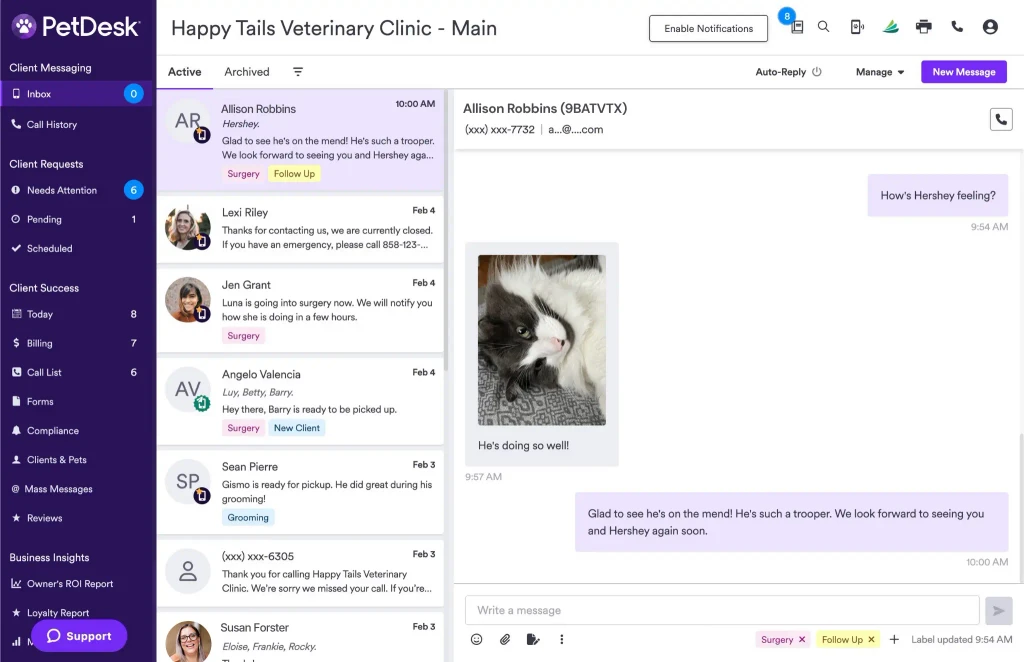
Two-way texting isn't a chatbot. It's a real inbox that’s visible to your team and manageable from a single screen—where clients can ask questions and get real answers from real people.
When a pet parent texts “Is Biscuit's prescription ready?” that message goes into your team's queue. Someone responds when they have a moment. The client gets an answer without waiting on hold. Your staff handles it without interrupting the flow of their day.
Because it integrates with your PIMS, the context is always there. Your team can see the client's history without switching systems or searching through notes.
You don't have to do it all at once
This point bears repeating: start with what creates immediate value and build from there. Two-way texting and automated reminders are the highest-leverage starting point because they reduce inbound call volume, improve confirmation rates, and free up front desk time almost immediately.
Direct online booking is the natural next step. And PIMS-integrated phones—while genuinely worth upgrading—can wait until the foundation is in place.
Modern communication isn't a destination you arrive at all at once. It's a direction you move in consistently. The practices doing it well didn't redesign everything in a month. They started with one change, saw the impact, and kept going.
Build lasting client bonds—automatically
Stay top-of-mind with every pet parent without adding to your daily to-do list. Our automated reminders and two-way messaging keep your clients connected to your care through the top-rated veterinary mobile app.