" height="8px" id="x_HOY8XyM" transform="translate(6.008 4)" width="4.015649999999994px"/></svg>)
" height="7.5px" id="CSiwjDzLM" transform="translate(5 4)" width="6.570300102233887px"/></svg>)
" height="5.684156997170297px" id="FuNtYuhE0" transform="translate(4 5.16)" width="8px"/></svg>)
" height="8px" id="MlOPP20GY" transform="translate(4 4)" width="8px"/></svg>)
Every veterinary practice wants to grow. But many have learned the hard way that adding clients without the right systems just means adding chaos: more calls, more manual reminders, more new clients who get a great first experience (and more who don't, depending on how busy the practice was that day).
Growth is supposed to feel like progress. When it doesn't—when more volume just means more strain on a team that was already stretched—it stops feeling worth it. Here's how to grow differently.
The growth paradox in veterinary medicine
In theory, the math is simple: more clients should mean more revenue. In practice, every new client is a new set of tasks: another call to book, another reminder to send, another follow-up to manage, another new client form to manually process at the busy front desk.
Without systems that scale, growth and chaos arrive together. The practices that grow sustainably aren't the ones with the most aggressive marketing. Instead, they're the ones with the infrastructure to absorb new volume without passing the burden to their staff.
The risks of adding new clients without adding new systems
Phone volume spikes. The front desk can't keep up. Hold times get longer. Calls get missed. And most importantly, clients notice.
Reminders start falling through the cracks and no-shows begin to increase. When routine reminders and follow-up calls are manual, they're the first things that get skipped on a busy day. That means more empty slots right that could have easily been filled through accurate automation.
New client onboarding becomes inconsistent. Some clients get a thorough, welcoming first experience, while others get a clipboard at the door and a hurried intake because the team is already behind. Inconsistency at the first visit is one of the fastest ways to lose a client before the relationship even starts.
Staff morale drops. The team that was already working hard gets asked to do more with the same resources. Burnout accelerates. And the growth that was supposed to improve the practice's health starts to threaten the team's well-being.
The infrastructure-first approach to growth
The smartest thing a practice can do before ramping up marketing is to build the systems that make growth manageable. This isn't about spending more. It's about making sure each new client costs less operational effort than the last.
Direct online booking means new clients can schedule without a phone call. They find you, they see availability, they book—all without your front desk being involved. That's a new client added with zero staff time spent on intake scheduling.
Automated intake forms allow new client information to arrive before they walk through the door. No clipboard scramble, no asking them to fill out paperwork while their anxious dog is eyeing the cat carrier two feet away. The information is there, it's organized, and check-in can actually be a welcome moment.
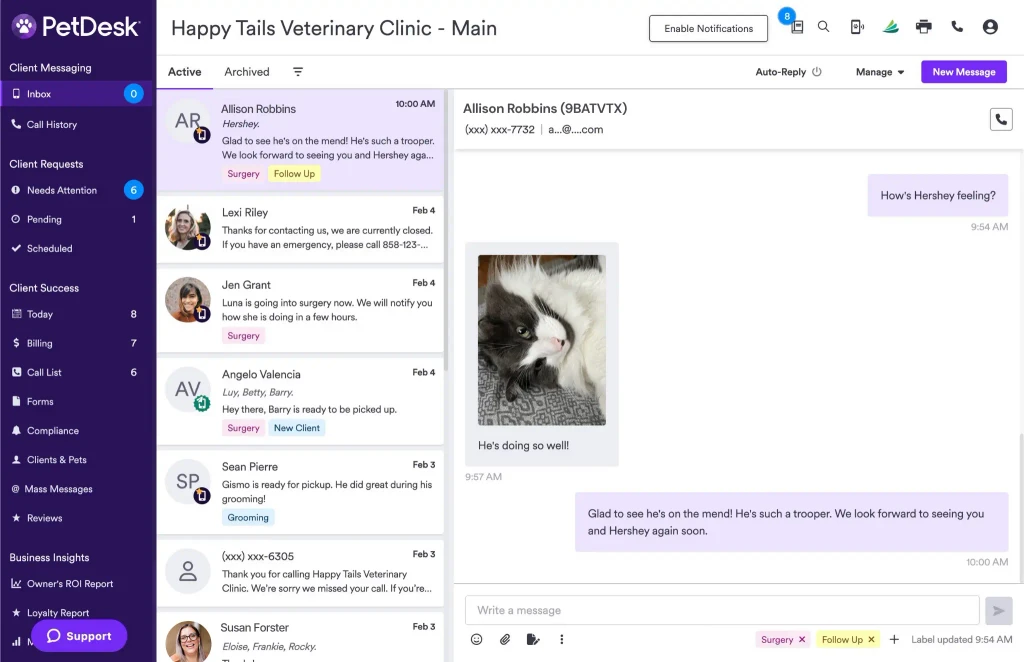
Automated reminders and confirmations and two-way texting ensure every new client gets a consistent experience (not the one they happen to get based on how busy the clinic was that day).
How automation makes each new client less work, not more
Here's what the intake process looks like when the systems are in place.
Booking confirms in real time: No back-and-forth, no holds, no callbacks.
Intake forms arrive before the visit: No manual data entry, no information gaps.
Reminders go out automatically: No manual calls, no missed confirmations.
Post-visit follow-ups are automated: A summary goes to the pet parent, a reminder to book their next visit goes out at the right time, without anyone on your team having to remember to send it.
Each new client adds revenue without adding proportional work. As volume scales, the practice is able to handle it.
Growth that the team feels good about
There's a version of growth where adding 20 new clients a month means 20 more calls a month, 20 more manual reminders, 20 more intake forms to process by hand.
But there's also a version where those 20 clients book themselves, receive automated reminders, fill out their forms before they arrive, and generate post-visit follow-ups without anyone on staff touching them. The difference isn't the number of clients, but instead the infrastructure underneath.
Practices that grow well don't just market well. They build the systems first, then scale into them. When they do, growth feels like what it's supposed to feel like: progress.
Build lasting client bonds—automatically
Stay top-of-mind with every pet parent without adding to your daily to-do list. Our automated reminders and two-way messaging keep your clients connected to your care through the top-rated veterinary mobile app.