" height="8px" id="x_HOY8XyM" transform="translate(6.008 4)" width="4.015649999999994px"/></svg>)
" height="7.5px" id="CSiwjDzLM" transform="translate(5 4)" width="6.570300102233887px"/></svg>)
" height="5.684156997170297px" id="FuNtYuhE0" transform="translate(4 5.16)" width="8px"/></svg>)
" height="8px" id="MlOPP20GY" transform="translate(4 4)" width="8px"/></svg>)

It’s true—feeling efficient and being efficient are not the same thing.
Veterinary practices are in a period of change. Plenty of clinics are still growing revenue, but the conditions that made growth predictable over the last few years are shifting. Appointment volumes are softer, labor costs keep rising, and training new hires takes longer than it used to. On top of that, clients expect a modern, convenient experience, and your team still has to deliver the personal care your practice is known for.
The good news is that this isn't an industry in decline. It's an industry being stretched in new ways, and our data shows some surprising contradictions. Practices are dealing with uncertain demand alongside inefficiencies that don't go away, technology that doesn't get used to its full potential, and limited visibility into what's actually driving their growth.
That's where the opportunity is. Some practices actively market to new and existing clients, remove friction from their operations, win back lost capacity, and focus on outcomes rather than just activity. Those practices are in a much stronger position to fill their schedules, grow revenue, and support their teams.
Our latest veterinary practice management data shows that the practices that close the gap between how efficient they think they are and how efficient they actually are will confidently lead the next chapter of veterinary care.
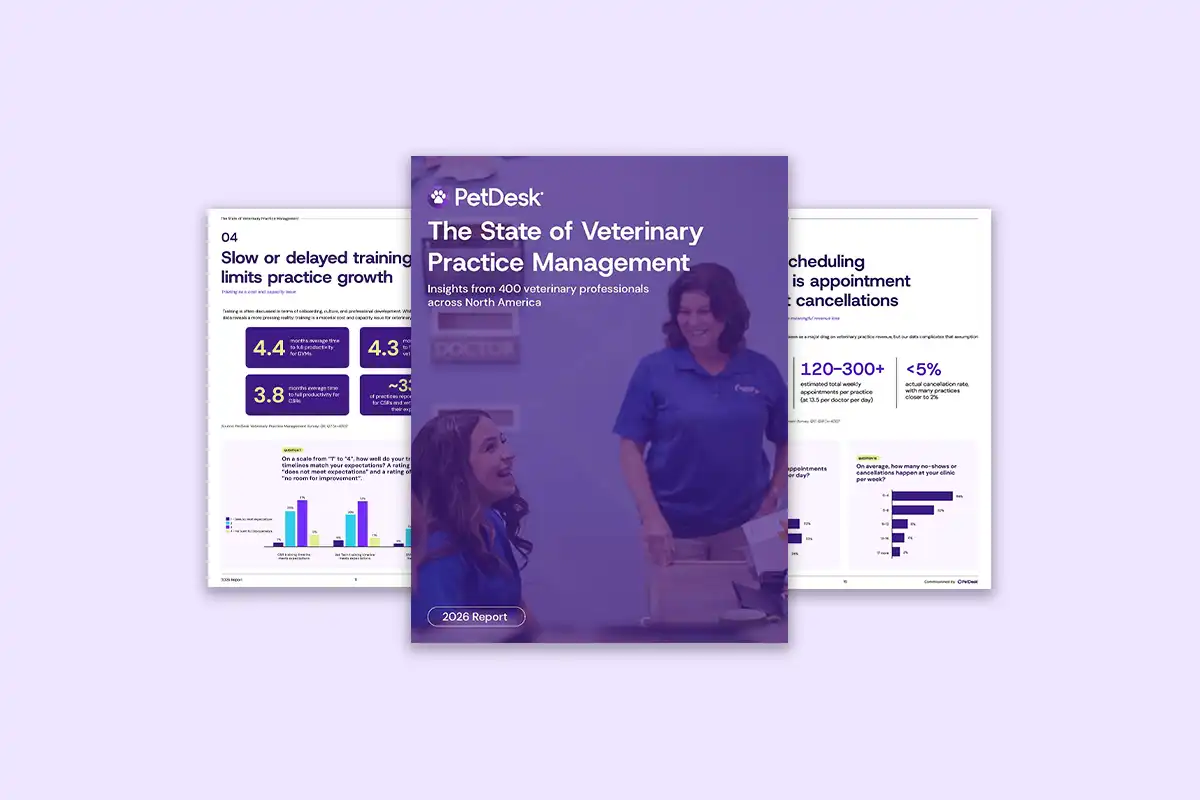
The following statistics come directly from PetDesk’s 2026 State of Veterinary Practice Management Report. In this study, we surveyed 400 practice owners and managers in North America to explore their views of practice operations, staffing and training, technology adoption, appointment management, profitability pressures, and client acquisition and retention.
1. Clinics feel anxious about growth even when revenue looks fine.
Nearly one in four (23%) practices worry they don't have enough appointments. Yet more than half report some year-over-year revenue growth. So what's going on?
We call it the demand paradox. The revenue numbers look steady, but practice managers can feel that something's off, and they're right. Much of that growth has come from price increases, and price increases can only take you so far. You can't raise prices forever to make up for a schedule that isn't as full as it should be. Practice managers know this, which explains the uneasy feeling even in a "good" year.
Profitability adds another layer. Staffing costs are still the top concern, but inventory costs and lower average transaction values are close behind. Put those together and margins are getting squeezed from both sides: costs are going up while the value of each visit is under pressure.
23% of practices cite "not being busy enough" as their top concern
~65% of practices reported revenue growth in 2025 vs. 2024
2. Most team members are doing more work than they signed up for.
If your CSRs are also handling inventory, or your techs are covering the front desk between appointments, you're not alone. Most staff (52%) regularly take on tasks outside their defined roles.
What's interesting is that most practices still describe themselves as well-run and efficient. The data tells a slightly different story. Training takes much longer than expected, and nearly every practice admits there's room to improve how administrative time is managed.
~40% of practices report staff frequently or daily performing tasks outside their defined roles
19 out of 20 practices indicate room for improvement in time management related to administrative work
Hiring doesn't bring relief as quickly as you'd hope, either. Nearly half of practices say new hires take three months or longer to reach full productivity. CSR and veterinary technician training are the most likely to fall short of expectations, and those are the roles that keep your day running.
So even when help is on the way, your current team carries the extra load for months. That's a fast track to occupational burnout.
~50%
of practices need 3+ months before new hires reach full productivity
4.4 months
average time to full productivity for DVMs
4.3 months
average time to full productivity for vet techs
3.8 months
average time to full productivity for CSRs
~33%
of practices report training timelines for CSRs and vet techs fall short of their expectations
3. Most clinics appreciate veterinary tech, but don't always use it to solve their biggest day-to-day headaches.
Veterinary practices generally value technology. Digital tools are widely used, and teams say they do make work more efficient.
Here's the catch: most practices don't connect their technology to the problems that keep them up at night, like staffing pressure, revenue growth, and profitability. When asked how their tools affect revenue growth, staff morale, or no-shows, many practices describe the impact as neutral.
That's a missed opportunity. The tools are already in place, but they're often used to handle tasks rather than to solve the business challenges that matter most. The difference between "we have the tech" and "the tech is moving the needle" usually comes down to intention: knowing which problem you're trying to solve and setting up your tools to solve it.
60%+ of practices use reminders, two-way texting, online booking, and client portals
~50% of practices report using some form of AI, most commonly for medical record summarization
4. The real problem isn't a no-show. It's appointment creep.
No-shows and cancellations get a lot of attention, and they're frustrating. But the actual no-show and cancellation rate is well below 5% and often closer to 2%. For most practices, it's a manageable problem.
The bigger issue is harder to spot. More than 25% of appointments run longer than scheduled.
Think about what that means in a typical day. A 20-minute appointment turns into 30. Then the next one starts late, lunch gets shorter, and by mid-afternoon your team is running behind and rushing to catch up. None of these moments looks like a crisis on its own, but together they quietly use up your capacity every day and wear down your staff.
Appointment creep is the scheduling challenge most practices aren't tracking, and it's costing more than cancellations are.
<5% actual cancellation rate, with many practices closer to 2%
~26% of appointments extend beyond the time originally scheduled
5. To keep growing and stay competitive, clinics need to get proactive with their marketing.
The days of easy visit growth are over. If clinics want to compete and grow, they'll need to market themselves actively.
Right now, most practices depend on word of mouth and a limited digital presence to bring in new clients. Word of mouth is valuable, but it's not a strategy you can plan, measure, or scale. The research shows most practices don't:
Track client acquisition costs
Maintain a formal marketing plan
Use loyalty programs to encourage more frequent visits
Without those basics, it's hard to know what's working, and harder still to grow in a sustainable way. The practices that treat marketing as an ongoing investment, not an afterthought, will be the ones that fill their schedules.
The veterinary industry is changing, and it needs a different kind of attention.
Across this research, a clear pattern shows up. Practices are growing but anxious about declining visits. They feel confident in their efficiency but carry hidden bottlenecks. They value technology but haven't tied it to their biggest challenges. And they depend on growth they can't fully see or measure.
The practices best positioned for the years ahead won't be the ones that just work harder or add more tools. They'll be the ones that close the gaps between perception and reality: between how efficient they believe they are and how efficient they actually are, between how much they value growth and how much they invest in it, and between the technology they have and the results it delivers.
In practice, that means getting clear visibility into your operations and treating training, scheduling, and marketing as strategic levers, not administrative chores. It also means recognizing that when demand is uncertain, every appointment, every staff hour, and every client relationship matters more than it did when demand was a given.
The opportunity is real, and you can act on it. Practices that find and fix hidden inefficiencies, use technology with intention, and build a consistent approach to attracting and keeping clients will be better equipped to fill their schedules, protect their profitability, and build lasting relationships with the pet parents and communities they serve.
Frequently asked questions (FAQ)
1. Why do veterinary practices feel anxious about growth when their revenue is up?
Much of the recent revenue growth has come from price increases, not more visits. Nearly one in four practices worry about low appointment volume, even though more than half report year-over-year revenue growth. Price increases can't keep growth going forever, so a schedule that isn't full is a real long-term concern, even in a strong year.
2. What's putting the most pressure on veterinary practice profitability?
Staffing costs are the top concern. Rising inventory costs and lower average transaction values follow close behind. Together, they squeeze margins from both directions: costs go up while the value of each visit comes under pressure.
3. How long does it take a new veterinary hire to become fully productive?
Nearly half of practices say new hires need three months or longer to reach full productivity. CSR and veterinary technician training are the most likely to fall short of expectations. In the meantime, your current team usually covers the gap, which can lead to burnout.
4. What is appointment creep, and why does it matter more than no-shows?
Appointment creep is when appointments run longer than scheduled. It happens in more than 25% of appointments, while no-shows and cancellations are usually well below 5% and often closer to 2%. Every appointment that runs over pushes back the rest of the day and uses up capacity. That's why creep quietly costs practices more than cancellations do.
5. Why isn't technology improving revenue or staff morale at many clinics?
Most practices value their digital tools and say those tools make work more efficient. But many don't connect them to their biggest business challenges, such as staffing pressure, revenue growth, and profitability. To get more out of your technology, start with a specific problem you want to solve, then set up your tools to solve it.
6. Is word of mouth enough to grow a veterinary practice?
Not anymore. Word of mouth is valuable, but you can't plan, measure, or scale it. Most practices don't track client acquisition costs, keep a formal marketing plan, or use loyalty programs to bring clients back more often. Practices that market consistently to new and existing clients are better positioned to fill their schedules.
7. What's the first step to closing the gap between perceived and actual efficiency?
Get visibility into how your practice actually runs. Track how often appointments run over, how long training takes, and where new clients come from. Once you can see where the gaps are, you can treat scheduling, training, and marketing as strategic levers instead of administrative chores.
8. What is the State of Veterinary Practice Management Report?
PetDesk commissioned an independent research study to better understand the operational, staffing, technology, and growth challenges facing veterinary practices today. The survey was distributed to 8,825 veterinary professionals across North America and conducted online between December 4 and December 19, 2025. A total of 400 completed responses were collected and analyzed. Survey topics included practice operations, staffing and training, technology adoption, appointment management, profitability pressures, and client acquisition and retention. The findings presented in the State of Veterinary Practice Management Report reflect aggregated responses and are intended to highlight industry-wide trends rather than individual practice performance.
The State of Veterinary Practice Management Report
We surveyed 400 veterinary professionals in North America, revealing a significant gap between how efficient practices believe they are, and how efficient they actually are. Download the data to prepare your practice for the next phase of veterinary success in 2026 and beyond.