Manually writing SOAP notes after every appointment is one of the biggest drivers of DVM burnout: late nights, missed lunches, and details that get fuzzy by the time you sit down to type. AI transcription software fixes this by automatically turning the client conversation you're already having into a structured note. The challenge is that not all veterinary AI scribes are built the same way, and the wrong pick can mean more editing instead of less.
We’re covering what to look for in the best veterinary AI transcription platform and comparing the leading options, so you can choose with confidence.
How to evaluate veterinary AI transcription software
Before comparing specific tools, it helps to know which differences actually matter for day-to-day use in a clinic.
" height="13px" id="OQFkXX6eI" transform="translate(1.334 1.667)" width="13.160999137218198px"/></svg>)
Veterinary-specific training
General-purpose dictation tools weren't built on veterinary language, species, or common cases. A model trained specifically for veterinary visits needs less manual correction and produces more usable notes from the start.
" height="13.333359999999994px" id="TskCOMC1T" transform="translate(2.667 1.333)" width="10.666640000000006px"/></svg>)
Learns from your corrections
The best tools improve the more your team uses them. If a tool can't learn from edits over time, you'll be doing the same corrections months from now that you did on day one.
" height="15.327290589509358px" id="b0L9cRQIy" transform="translate(2.001 0.331)" width="11.999238633488416px"/></svg>)
PIMS integration, not just export
Look for a scribe that pulls your schedule and writes notes directly into your PIMS, not one that requires you to copy and paste between systems.
" height="12px" id="WCFlm7JNA" transform="translate(2 2)" width="12px"/></svg>)
Client summaries, not just SOAP notes
A transcription tool that also generates a plain-language summary for pet parents saves a second round of writing and improves compliance with treatment plans.
" height="9.999960167419124px" id="aH3NyBEIK" transform="translate(1.333 3.333)" width="13.333344041731198px"/></svg>)
Pricing model and contract terms
Ask whether pricing is per-provider, per-clinic, or usage-based, and whether it requires a long-term contract.
Comparing the top veterinary
AI transcription tools
Comparing the top veterinary AI transcription tools
Practices that want AI documentation alongside communication, booking, and phones in one platform.
Practices that want AI documentation alongside communication, booking, and phones in one platform.
Clinics prioritizing fast, low-friction note generation.
Clinics prioritizing fast, low-friction note generation.
Clinics that want scribing plus callback and client communication support.
Clinics that want scribing plus callback and client communication support.
Teams that want scribing with broader automation, including lab integrations.
Teams that want scribing with broader automation, including lab integrations.
PetDesk Scribe
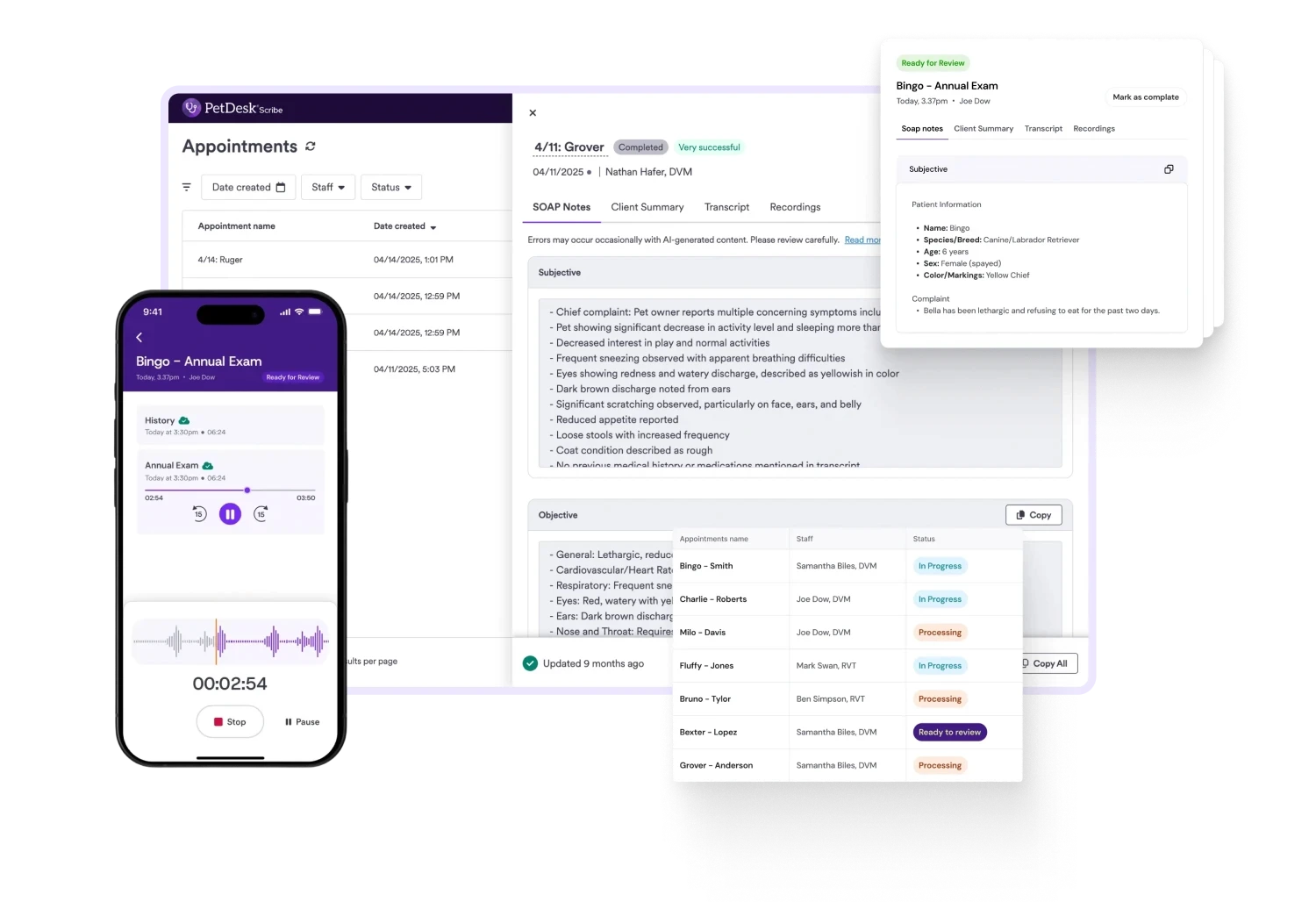
PetDesk Scribe records client appointments and automatically produces fully formatted SOAP notes and client-friendly summaries—no manual typing required. The AI model is trained specifically on veterinary language and use cases, and it continues to improve the more your team uses it, meaning less editing over time rather than the same level of correction month after month. Because Scribe pulls your daily schedule directly from PIMS including Avimark, Cornerstone, ImproMed, ezyVet, and Pulse, users can start recording with a single tap rather than searching for the right patient file.
Scribe is also part of PetDesk's full client engagement platform, so practices already using PetDesk Communications, Phones, or Direct Booking add AI documentation without introducing a new vendor or a separate login.
"I have tried several AI scribe applications, and I feel like PetDesk Scribe has done the best job of accurately and thoroughly capturing the appointment as a whole—history, exam, plan, recommendations. I've done less editing with this program than with any other that I've tried."
—Dr. Jennifer Nunnery, DVM, Family Pet Health
Scribenote
Scribenote focuses on fast SOAP note generation with a design built to reduce clicks during the appointment. It includes a select-and-replace feature that speeds up review by letting a provider quickly swap specific words or phrases throughout a note. Scribenote is purpose-built for veterinarians, but it operates as a standalone scribe rather than part of a broader client engagement suite—practices that want scheduling, reminders, and communication tools alongside their scribe will need to manage those separately.
Talkatoo
Talkatoo pairs AI transcription with client communication features, including callback support. It's a reasonable fit for practices that want scribing bundled with some front-desk communication tools. One tradeoff to check before choosing: Talkatoo's transcription doesn't appear to learn from corrections over time, so the editing workload may stay flatter than with tools that improve with use.
CoVet
CoVet generates SOAP notes and extends into broader automation, including client communication and lab integrations. That range of features is a strength for practices that want one tool to cover more ground, but it can also mean a steeper learning curve—teams that are less comfortable with tech-heavy tools may find the number of customization options overwhelming at first.
Frequently Asked Questions
Is AI transcription accurate enough to trust without review?
Every tool on this list is designed for provider review before notes are finalized—none are meant to be fully autonomous. The real differentiator is how much editing that review requires. Veterinary-tuned models trained on real clinic language and cases typically need far less correction than general-purpose dictation tools adapted for medical use.
Does veterinary AI scribe software replace my PIMS?
No. AI transcription tools are designed to write into your existing PIMS, not replace it. Look for a scribe with a direct, real-time PIMS connection rather than one that requires manual export and import.
How much does veterinary AI transcription software cost?
Pricing varies by vendor and is often based on the number of providers, the clinic's size, or usage volume. Ask each vendor directly, and check whether the price includes support and onboarding or whether those are billed separately.
Can I use an AI scribe without switching my other veterinary software?
Yes, in most cases. Tools like PetDesk Scribe can be added on their own and connect to your existing PIMS, so you don't need to change your practice management system to start using AI transcription.
Frequently Asked Questions
Is AI transcription accurate enough to trust without review?
Every tool on this list is designed for provider review before notes are finalized—none are meant to be fully autonomous. The real differentiator is how much editing that review requires. Veterinary-tuned models trained on real clinic language and cases typically need far less correction than general-purpose dictation tools adapted for medical use.
Does veterinary AI scribe software replace my PIMS?
No. AI transcription tools are designed to write into your existing PIMS, not replace it. Look for a scribe with a direct, real-time PIMS connection rather than one that requires manual export and import.
How much does veterinary AI transcription software cost?
Pricing varies by vendor and is often based on the number of providers, the clinic's size, or usage volume. Ask each vendor directly, and check whether the price includes support and onboarding or whether those are billed separately.
Can I use an AI scribe without switching my other veterinary software?
Yes, in most cases. Tools like PetDesk Scribe can be added on their own and connect to your existing PIMS, so you don't need to change your practice management system to start using AI transcription.
Frequently Asked Questions
Is AI transcription accurate enough to trust without review?
Every tool on this list is designed for provider review before notes are finalized—none are meant to be fully autonomous. The real differentiator is how much editing that review requires. Veterinary-tuned models trained on real clinic language and cases typically need far less correction than general-purpose dictation tools adapted for medical use.
Does veterinary AI scribe software replace my PIMS?
No. AI transcription tools are designed to write into your existing PIMS, not replace it. Look for a scribe with a direct, real-time PIMS connection rather than one that requires manual export and import.
How much does veterinary AI transcription software cost?
Pricing varies by vendor and is often based on the number of providers, the clinic's size, or usage volume. Ask each vendor directly, and check whether the price includes support and onboarding or whether those are billed separately.
Can I use an AI scribe without switching my other veterinary software?
Yes, in most cases. Tools like PetDesk Scribe can be added on their own and connect to your existing PIMS, so you don't need to change your practice management system to start using AI transcription.
Ready to see how PetDesk Scribe fits into your practice?


" height="13.333325000000002px" id="Kf6vwCqaO" transform="translate(1.334 1.333)" width="13.33331499999997px"/><path d="M 5.134 0.159 L 2.154 3.139 L 0.841 1.826 C 0.746 1.737 0.621 1.689 0.491 1.692 C 0.362 1.694 0.238 1.746 0.146 1.838 C 0.055 1.93 0.002 2.053 0 2.183 C -0.002 2.312 0.046 2.438 0.134 2.532 L 1.801 4.199 C 1.895 4.293 2.022 4.345 2.154 4.345 C 2.287 4.345 2.414 4.293 2.508 4.199 L 5.841 0.866 C 5.89 0.82 5.929 0.765 5.957 0.703 C 5.984 0.642 5.999 0.576 6 0.509 C 6.001 0.442 5.989 0.375 5.964 0.313 C 5.938 0.25 5.901 0.194 5.854 0.146 C 5.806 0.099 5.75 0.062 5.687 0.036 C 5.625 0.011 5.558 -0.001 5.491 0 C 5.424 0.001 5.358 0.016 5.297 0.043 C 5.235 0.071 5.18 0.11 5.134 0.159 Z" fill="rgb(222, 239, 145)" height="4.345329770034447px" id="Rsc86Zs4i" transform="translate(5.013 5.821)" width="6.000008611866147px"/></svg>)