" height="8px" id="x_HOY8XyM" transform="translate(6.008 4)" width="4.015649999999994px"/></svg>)
" height="7.5px" id="CSiwjDzLM" transform="translate(5 4)" width="6.570300102233887px"/></svg>)
" height="5.684156997170297px" id="FuNtYuhE0" transform="translate(4 5.16)" width="8px"/></svg>)
" height="8px" id="MlOPP20GY" transform="translate(4 4)" width="8px"/></svg>)

Your team didn't go into veterinary medicine to spend two hours after closing typing notes. But, unfortunately for many practices, that's exactly what happens.
The last patient leaves at 6pm, the front desk is still working at 6:30, the vet is still at her desk at 7pm finishing SOAP notes that accumulated throughout the day. The technician is updating records, flagging follow-ups, logging callbacks that didn't happen yet.
This isn't a discipline problem or a staffing problem. It's a systems problem—and it's driving some of the best people in veterinary medicine toward occupational burnout.
The second shift nobody signed up for
According to AVMA, more than 60% of veterinarians report high levels of exhaustion. The number one driver isn't patient volume, but rather administrative overload. Manual charting, appointment reminder calls, follow-up phone tags, after-hours documentation: none of this is why your team chose this profession, and yet all of it adds up.
The second shift is the work that happens after the last patient. It's invisible from the outside, unmeasured in most practices, and quietly wearing down the people who work hard to power your clinic.
Why burnout is a business problem, not just a people problem
Burned-out staff leave, and replacing them (which involves recruiting, hiring, onboarding, training) is expensive, time-consuming, and disruptive to the clients and patients who knew them.
There's also an attraction problem. According to recent data, 47% of veterinary professionals say that technology influences where they choose to work. Another survey reveals that 75% say new technologies are moderately to extremely important to their job satisfaction. This proves that your technology stack isn't just an operational decision—it's part of your employment brand.
The practices that are attracting and retaining good people in a tight labor market aren't just offering competitive compensation. They're offering a workday that ends when it's supposed to end.
The automation mindset shift
Automation in vet practices isn't about replacing people. It's about removing the tasks that drain them—the repetitive, administrative, low-judgment work that doesn't require a credentialed professional but ends up consuming their time anyway.
There are three categories of work that are highly automatable in most practices: reminders, documentation, and routine client communication. When each one of these is removed from the manual task list, your staff gets greater capacity and energy in return. That’s energy that can go toward patient care, client relationships, and actually leaving work on time.
What this looks like in a real practice day
Appointment reminders go out automatically. No morning call list, no manual outreach, no front desk time spent on confirmations that could run themselves.
PetDesk Scribe captures visit notes in real time and generates clear summaries for pet parents. No after-hours typing, no trying to reconstruct what happened earlier at 4pm when it's now 7pm. The documentation gets done during the visit, not after it.
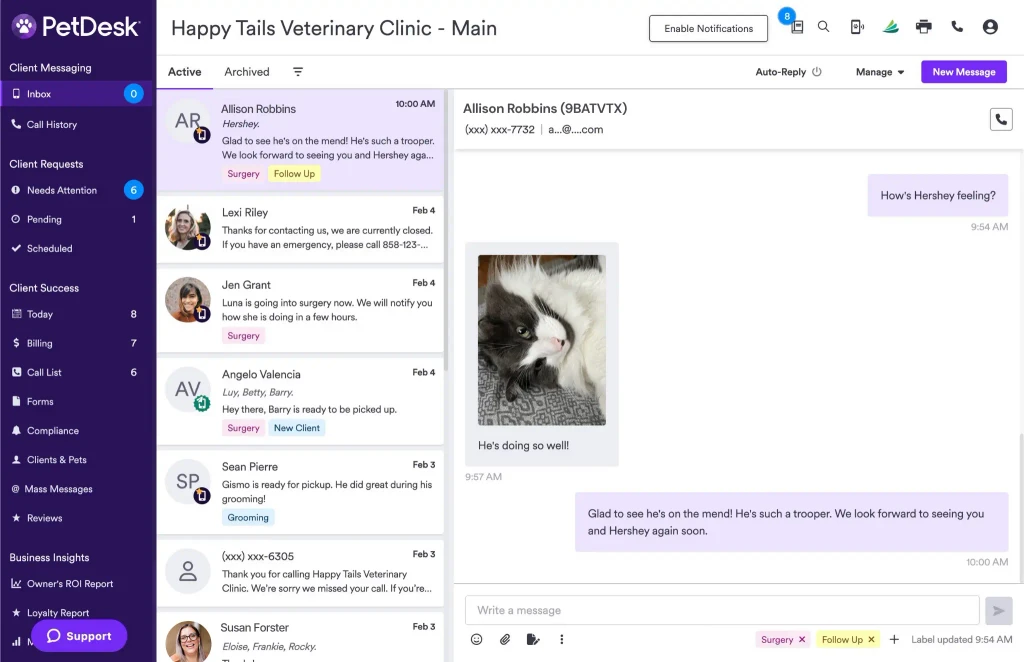
Client questions come in via two-way text messages and get handled from a single inbox when the team is ready. No phone tag, no voicemail pile, no interruptions that derail the flow of the day.
The front desk ends the day having actually completed their work—not having caught up to where they were yesterday.
The multiplier effect
When your team isn't burned out, patient care improves. Clients notice when staff are engaged, unhurried, and genuinely present during an appointment. They notice the difference between a practice where everyone seems exhausted and one where people seem to actually like being there.
Less turnover means a team that knows your clients, knows your systems, and knows your standards. It means the relationships your staff builds with regular clients don't have to be rebuilt every time someone leaves.
Investing in tools that reduce administrative burden isn't just about efficiency. It's about building a practice where people want to stay—and where the quality of care reflects that stability.
With the right veterinary-specific tools in place, the second shift of the day becomes optional.
Go home on time with AI-powered medical charting
Stop spending your lunch breaks and evenings on records. PetDesk’s AI Scribe captures every detail of your exam in real-time, generating accurate SOAP notes so you can focus on the patient—and get out the door when the shift ends.