" height="8px" id="x_HOY8XyM" transform="translate(6.008 4)" width="4.015649999999994px"/></svg>)
" height="7.5px" id="CSiwjDzLM" transform="translate(5 4)" width="6.570300102233887px"/></svg>)
" height="5.684156997170297px" id="FuNtYuhE0" transform="translate(4 5.16)" width="8px"/></svg>)
" height="8px" id="MlOPP20GY" transform="translate(4 4)" width="8px"/></svg>)
For years, veterinary technology has been positioned as a lever for growth—more appointments booked, higher preventive care compliance, better revenue capture. Much of the conversation has focused on efficiency and output: how to see more patients, communicate with more clients, and do more with less.
But that framing misses a critical truth many veterinary practices are now confronting: technology decisions are no longer just business decisions—they are workforce decisions.
Veterinary staff burnout continues to rise and employee retention is becoming one of the defining challenges facing the profession. That's why the practices seeing sustainable success today are reframing veterinary technology not as a productivity tool alone, but as infrastructure for staff satisfaction, engagement, and long-term practice performance.
Staff satisfaction and practice performance are the same problem
Veterinary staff satisfaction is often discussed as a “people issue,” while practice performance is treated as an operational or financial problem. In reality, these two outcomes are tightly coupled—and separating them creates blind spots that make both harder to solve.
When teams are overwhelmed by constant interruptions, manual processes, and reactive workflows, the effects add up quickly:
Employee engagement declines as work feels chaotic and unsustainable
Morale erodes when effort doesn’t translate into progress or stability
Turnover increases, compounding stress for the staff who remain
Efficiency and consistency suffer, impacting both care delivery and client experience
Over time, these conditions create a vicious cycle: short staffing increases pressure, pressure accelerates burnout, and burnout drives further turnover.
Conversely, when practices intentionally reduce friction and create space for meaningful, focused work, performance improves as a natural outcome—not a forced one. Teams that feel supported are more resilient, more consistent, and better equipped to deliver high-quality care.
Where veterinary technology makes the greatest impact (and where it often misses)
The most effective veterinary technology does not attempt to perfect everything at once. Instead, it focuses on a small number of high-friction areas that drive burnout and disengagement.
1. Communication load is a burnout multiplier
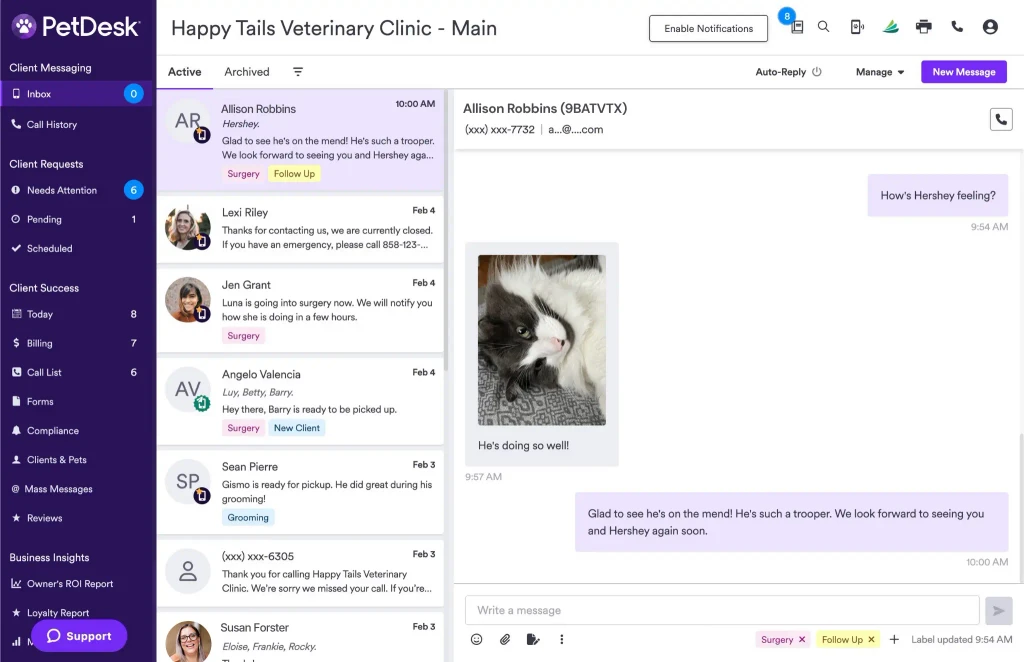
Few factors contribute more to daily stress than phone-heavy, interruption-driven communication. Constant ringing phones, repeated appointment confirmations, and fragmented client requests make it difficult for staff to focus, prioritize, or feel in control of their day.
Veterinary technology that enables automated and centralized communication helps reduce cognitive overload and restore focus. Proactively handling reminders, confirmations, and follow-ups allows teams to spend less time reacting and more time delivering care. That means preventing burnout for staff and improving the experience for clients.
2. Automation should protect time, not just increase output
Automation is often introduced to increase volume: more reminders sent, more appointments filled, more tasks completed. But automation that increases workload without reducing stress often backfires.
The most valuable automation protects staff time by removing repetitive, low-value administrative work. When teams are freed from manual, routine tasks, they can focus on work that feels more meaningful and rewarding.
3. Team visibility enables better leadership decisions
Burnout is rarely spontaneous; it's built over time. Practice owners and managers often sense that something is wrong, but lack the visibility needed to intervene early.
Veterinary technology that identifies scheduling patterns, missed appointments, communication bottlenecks, or workflow strain allows leaders to act sooner and more effectively. Better team visibility supports smarter staffing decisions, more realistic expectations, and a healthier workplace culture.
The shift from “efficiency tools” to “support systems”
Forward-thinking veterinary practices are beginning to evaluate technology through a different lens. Instead of asking what a tool can simplify, they ask how it will affect the daily routine and experience of their teams.
Thoughtful veterinary leaders are asking:
Will this technology make my team’s days more predictable?
Does it reduce interruptions, or introduce new ones?
Will it help my staff feel more in control of their work?
When veterinary technology is thought about through this lens, it becomes a stabilizing force instead of another demand placed on already stretched teams. This helps to support consistency, reduces unnecessary stress, and reinforces healthier ways of working.
Bonus tool: SignalPET
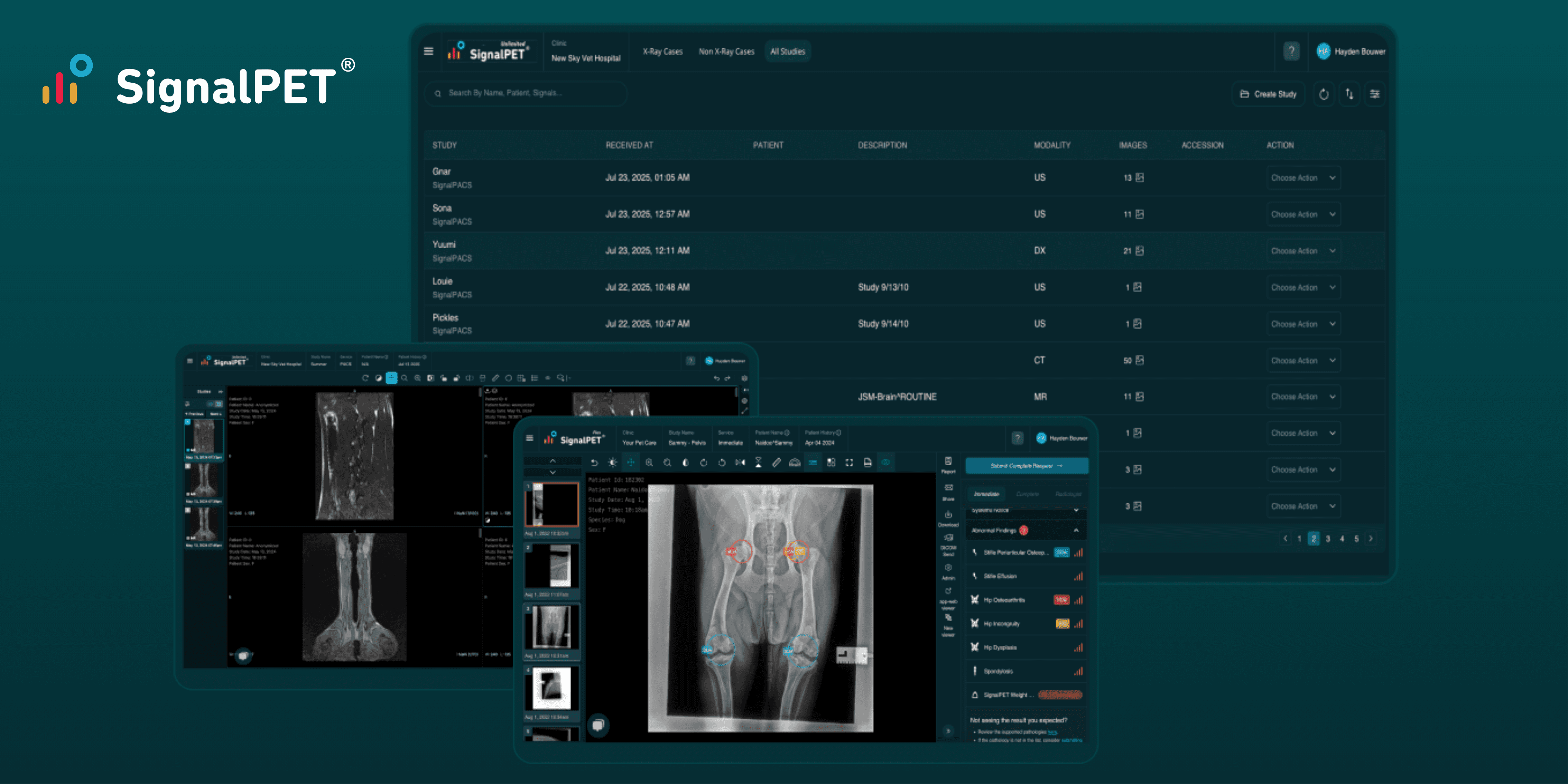
Diagnostic imaging is another area where technology can support busy veterinary teams. SignalPET 360 integrates AI-powered radiology assistance into the clinical workflow, enabling practices to review radiographs more efficiently, gain deeper diagnostic insights when necessary, and escalate cases to board-certified radiologists for specialist interpretation.
For teams aiming to reduce friction and enhance consistency, SignalPET empowers clinicians to make more confident imaging decisions while clearly communicating next steps with pet owners.
Learn more about SignalPET: signalpet.com
Rethink veterinary technology for your practice
Veterinary practices do not have a technology adoption problem—they have a technology alignment problem.
The future of strong practice performance depends on tools that:
Reduce burnout instead of simply masking it
Support employee engagement, not just output
Strengthen team culture while improving practice efficiency
Practices that lead with people and use the right veterinary technology to support them will be the ones that retain talent, deliver better care, and grow sustainably in an increasingly challenging environment.
Modernize your practice with a tech suite that fits your workflow
Your PIMS is your core. PetDesk’s communication and client engagement platform takes your clinic beyond the limits with tools like two-way texting, 24/7 direct booking, PIMS-compatible phones, AI-generated notes, and much more.