" height="8px" id="x_HOY8XyM" transform="translate(6.008 4)" width="4.015649999999994px"/></svg>)
" height="7.5px" id="CSiwjDzLM" transform="translate(5 4)" width="6.570300102233887px"/></svg>)
" height="5.684156997170297px" id="FuNtYuhE0" transform="translate(4 5.16)" width="8px"/></svg>)
" height="8px" id="MlOPP20GY" transform="translate(4 4)" width="8px"/></svg>)
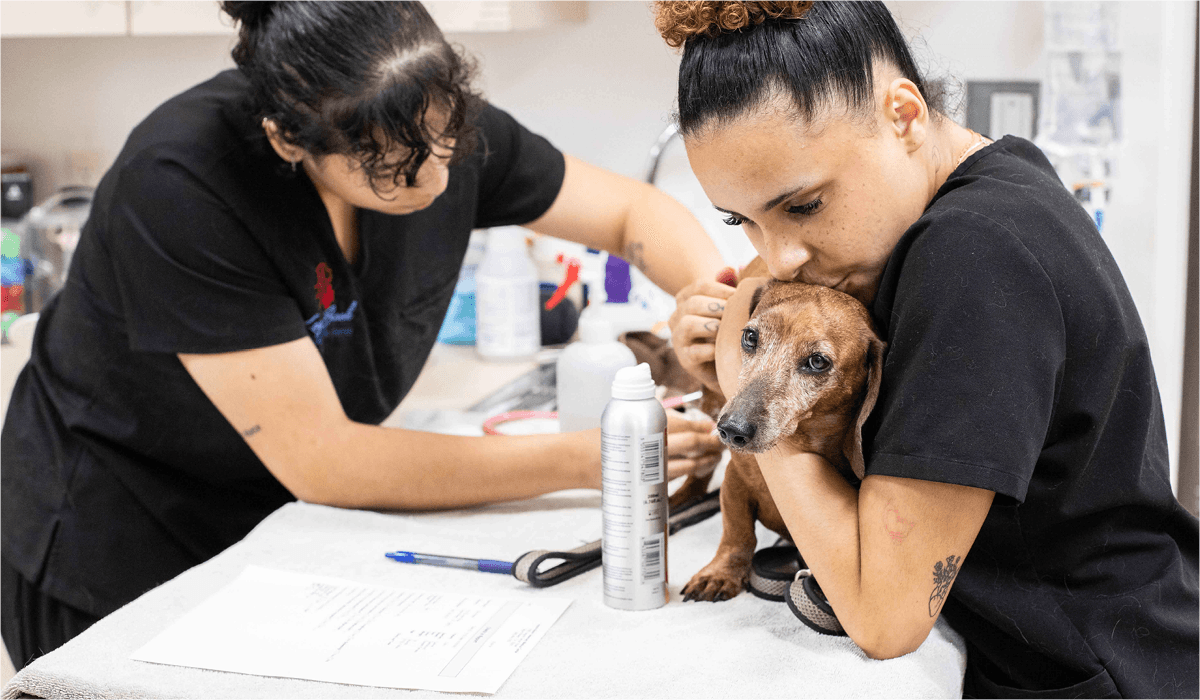
Veterinary clinics today are operating under constant pressure: high caseloads, limited staffing, rising client expectations, and increasing documentation demands. While these challenges are often discussed in terms of efficiency or burnout, a more accurate underlying problem is frequently overlooked: daily workflow interruptions.
These interruptions are distracting and risk slow clinical decision-making, not to mention pushing critical work into after-hours personal time. Saving time for staff is less about moving faster and more about protecting focus across the entire care journey. The most effective veterinary technology tools are those that not only reduce unnecessary distractions and manual rework, but also quietly support each team member’s role in the practice.
Why workflow interruptions are the real productivity killer
In a typical day, veterinary staff are interrupted by:
Ringing phones and repeated call-backs
Manual appointment scheduling and rescheduling
Incomplete client intake information
Disjointed documentation workflows
Follow-up questions that could have been resolved asynchronously
Each interruption may only take a few minutes, but the cumulative effect is substantial. Research across healthcare consistently shows that task switching increases cognitive load, extends task completion time, and contributes directly to staff burnout. This often shows up as late nights finishing records, stressed front-desk teams, and reduced appointment capacity.
Rethinking “time savings” to support the entire team
A key blind spot in many clinics is viewing time savings as a veterinarian-only problem. In reality, staff time is protected by tools that support client self-service, reduce inbound noise, and simplify collaboration across the team.
Modern veterinary technology addresses the unique needs of specific clinics and their team members, rather than forcing everyone into a single workflow.
How the right tools support each clinic’s brand
Veterinarians: fewer disruptions, more clinical focus
For veterinarians, the biggest time drains tend to happen outside of the exam room—manual documentation, repetitive follow-ups, and fragmented information.
Modern veterinary tools like AI-assisted clinical documentation and scribing reduce the need to mentally replay client conversations after appointments. By automatically capturing dialogue and structuring notes in real time, veterinarians can complete records closer to the point of care, which reduces after-hours charting and mental fatigue. When documentation fits naturally into the visit, vets spend more time focusing on pet care and less time transcribing.
Just as importantly, fewer interruptions from phone calls or last-minute scheduling issues allow veterinarians to maintain focus during exams, improving team efficiency and quality of care.
Veterinary technicians and nurses: smoother hand-offs, clearer context
Vet techs are focused on handling intake, assisting in exams, coordinating diagnostics, and managing follow-ups. Workflow interruptions for vet techs usually come from missing information or unclear next steps.
Veterinary communication tools like digital intake forms, automated appointment workflows, and structured visit summaries help ensure technicians have the right information at the right time. When client details, reason-for-visit, and prior history are all recorded in advance, vet techs spend less time clarifying basics and more time supporting patient care.
Reducing reactive work also helps technicians maintain a predictable schedule during the day, which is important for team morale and retention.
Veterinary client service representatives: fewer calls, better conversations
Front-desk veterinary teams experience some of the most interruptions in the clinic. Phones ringing continuously, appointment requests, and routine questions create constant task switching.
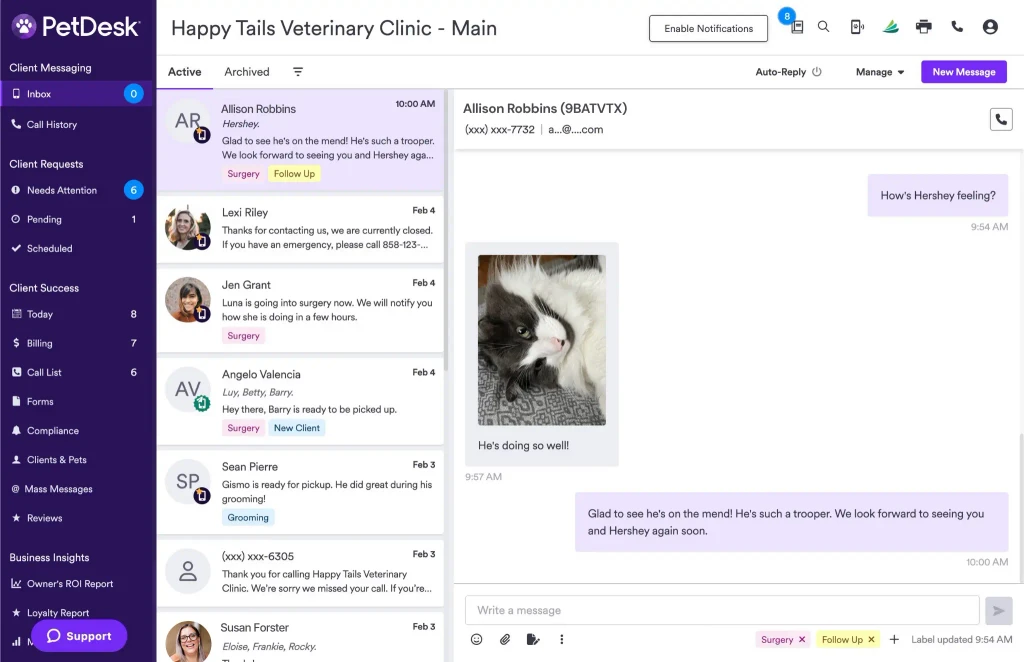
Veterinary communication tools, PIMS-compatible phones, and 24/7 direct booking software enable self-service scheduling, automated reminders, and convenient messaging, which work together to dramatically reduce daily call volume. Instead of handling repetitive requests, CSRs can focus on higher-value interactions such as supporting complex cases, resolving issues, and creating a better client experience.
Most importantly, this new level of automation doesn’t eliminate human connection; it protects it by reserving staff time for conversations that actually require empathy and support.
Practice managers and owners: predictability and capacity
For veterinary practice managers and owners, interruptions often come in the form of overtime hours, inconsistent appointment flow, and increased staffing stress.
When appointment booking, client communications, and automated documentation workflows are in sync, practice managers are able to gain a clearer visibility into capacity and performance. Fewer no-shows, shorter visit cycles, and reduced after-hours work translate into measurable operational gains. Over time, this stability supports better staffing decisions, improved margins, and a more sustainable practice model.
Integrated veterinary tools are a game-changer
The greatest impact comes not from any single feature, but from how tools work together:
Fewer phone calls mean fewer interruptions for clinicians
Better intake data shortens exams and documentation time
Streamlined documentation reduces follow-up questions
Clear communication reduces rework across the team
User-friendly solutions such as PetDesk Communications, PetDesk Phones, PetDesk Direct Booking, and PetDesk Scribe are built to simplify veterinary clinics and strengthen their care, without staff or clients having to spend time adjusting to the software. That means you can easily use veterinary technology to help your team work smarter in the background, enabling each team member with greater focus and confidence each workday.
Modern veterinary practices succeed through focus, not speed
The future of veterinary efficiency isn’t about pushing teams to work faster. It’s about designing systems that truly protect attention. Clinics that invest in interruption-reducing technology are better positioned to:
Retain clients and staff
Expand appointment capacity without burnout
Deliver more consistent care experiences
For practices looking to invest in new tools, the most important question isn’t “How much time does this save?” but rather: “Which interruptions does this remove—and for whom?”
Answering that question genuinely is often the difference between incremental improvement and meaningful, lasting change.
Frequently asked questions (FAQs)
1. Can automation improve the client experience without losing human connection?
Absolutely. By automating repetitive tasks like scheduling and reminders, staff are freed up to focus on higher-value interactions that require empathy and personal support for complex cases.
2. How does AI transcription technology help veterinarians save time?
AI-generated transcription tools allow veterinarians to capture dialogue and structure notes in real time, reducing the need for after-hours charting and manual transcription.
3. What role does direct booking software play in reducing interruptions?
24/7 direct booking enables client self-service, which significantly reduces inbound call volume for the front-desk team, allowing them to focus on clinical tasks and in-person client service.
Reclaim your day from administrative burnout
From error-free 24/7 booking to seamless PIMS integration, PetDesk streamlines your operations so your team can focus on caring for pets, not answering phone calls.