" height="8px" id="x_HOY8XyM" transform="translate(6.008 4)" width="4.015649999999994px"/></svg>)
" height="7.5px" id="CSiwjDzLM" transform="translate(5 4)" width="6.570300102233887px"/></svg>)
" height="5.684156997170297px" id="FuNtYuhE0" transform="translate(4 5.16)" width="8px"/></svg>)
" height="8px" id="MlOPP20GY" transform="translate(4 4)" width="8px"/></svg>)
Veterinary practices in 2026 are navigating a demand paradox. Most clinics are still growing, but that growth feels less predictable than it used to. Pandemic-era pet ownership has plateaued, costs are climbing, and pet parents are getting more deliberate about how they spend on care. Meanwhile, staffing pressure, longer training timelines, and quietly shifting appointment patterns are chipping away at capacity behind the scenes.
But the good news is that the path forward starts with a few honest answers from your veterinary team. We've put together five important questions that surface hidden bottlenecks, reveal real opportunities, and help your practice protect what is most important: your time, your team, and the care you provide.
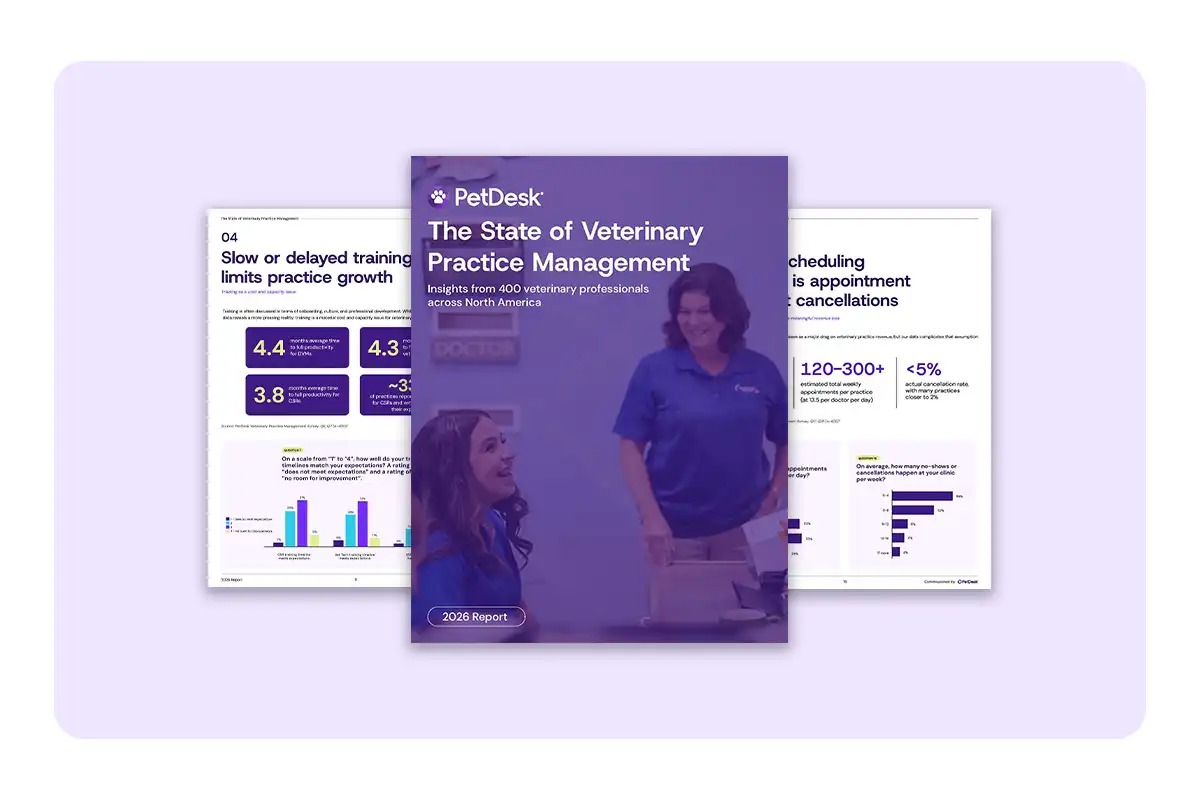
The following statistics come directly from PetDesk’s 2026 State of Veterinary Practice Management Report. In this study, we surveyed 400 practice owners and managers in North America to explore their views of practice operations, staffing and training, technology adoption, appointment management, profitability pressures, and client acquisition and retention. Our findings reveal a significant gap between how efficiency practices believe they are, and how efficient they actually are.
5 questions your veterinary team needs to answer in 2026
1. Are we feeling appointment-stressed?
For the past several years, "too busy" was just the default setting. Practices were drowning in demand with packed schedules, staff stretched thin, and operational strain the biggest problem to solve.
Now, that's beginning to shift. While most practices are still growing, the anxiety today isn't really about losing business—it's about whether that business feels predictable and sustainable. When growth is modest, fueled mostly by price increases instead of more visits, and stacked against rising costs, even good revenue numbers can feel a little fragile.
A few things are driving this shift. The pandemic pet boom has leveled off, puppy and kitten visits aren't coming as frequently, and pet parents are getting choosier about how they spend. At the same time, staffing costs remain elevated and training timelines keep stretching. Managing appointment capacity has gotten a lot more complicated than it used to be.
Instead of asking “How do we keep up?” the new question has become "How do we make the most of the capacity we have while competing effectively in a competitive market?”
|
2. Do we regularly perform tasks outside of our roles?
Most practices feel pretty well-run. But the latest data tells a slightly different story: training timelines are running longer than expected, and nearly every practice admits there's room to improve how they manage administrative time.
Here's the thing: working hard isn't the same as working efficiently. When team members regularly step outside their primary roles to keep things moving, it shows great teamwork—but it also points to operational strain that quietly drains productivity.
The biggest culprits behind workflow slowdowns are staffing shortages, training time, charting and note-taking, and client communication—all of which compound on each other. One bottleneck quietly creates the next: a shortage of trained staff adds pressure to team members who are already trained and working; longer training timelines delay new hire productivity; manual charting stretches appointments; communication gaps create follow-up calls and rework; and so on.
|
3. Are long training timelines taking us away from revenue-generating work?
We usually talk about training in terms of onboarding, culture, and professional development. But the data points to something more pressing: training is a real cost and capacity issue.
New team members need supervision and hands-on guidance, which pulls experienced staff away from revenue-generating work. During that ramp-up period, your practice operates below full capacity while still carrying full labor costs. This adds up fast.
Veterinary technicians are an especially critical pressure point. Vet tech training is one of the most likely areas to fall behind expectations, yet techs are central to patient flow, documentation, and client communication. When their productivity lags, you feel it everywhere—from scheduling to service efficiency.
Practices that can shorten time-to-productivity gain immediate capacity without adding headcount. They protect margins, stabilize schedules, and ease the burnout building among the experienced staff who are carrying the load.
|
4. Are we using veterinary technology to solve our biggest challenges?
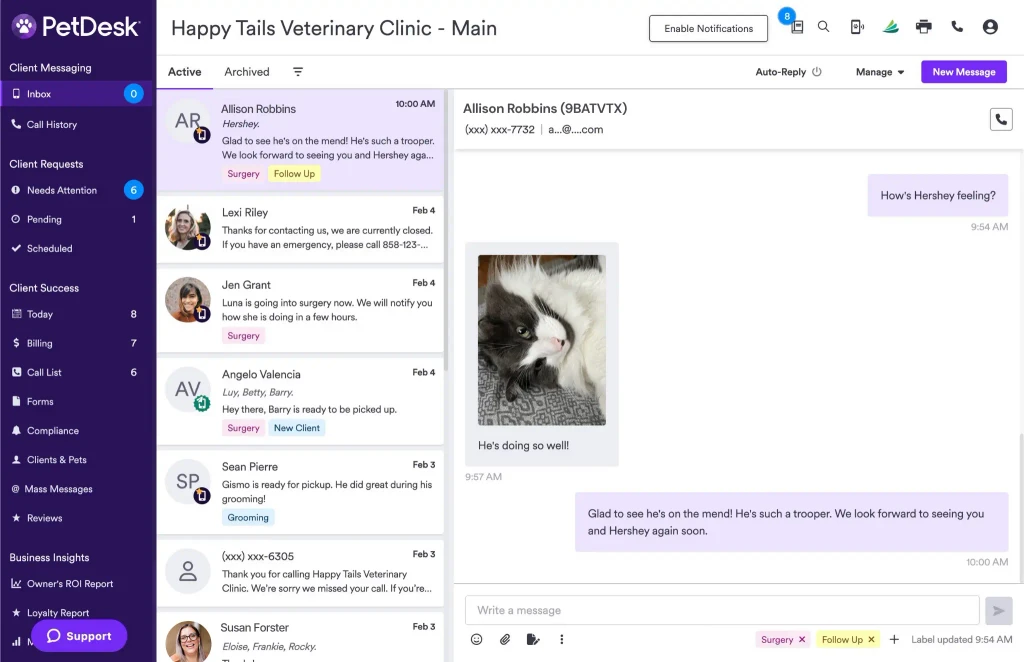
Practices are adopting veterinary-specific technology at a rapid rate. Whether it’s automated reminders, two-way texting, refill requests, direct online appointment booking, or AI-transcribed SOAP notes, these tools are everywhere now.
But the picture is more nuanced than it looks: while most practices say technology has had a somewhat positive impact on operational efficiency, practice managers struggle to point to a real impact on staff morale, revenue, or no-shows. In those areas, technology often feels neutral.
The disconnect is that practices broadly love technology but don't connect it to the problems that actually keep them up at night: staffing challenges and profitability pressure. Tech is valued as a convenience tool, but underrecognized as a strategic lever for solving core business problems. That's not a technology problem. It's a utilization and integration problem.
AI adoption follows a similar pattern. About half of practices report using AI in some form, most often for medical record summarization. The reasons others haven't adopted are all over the map: unclear benefits, knowledge gaps, concerns about implementation time. There isn't one big barrier holding the industry back—just a wide spread of small hesitations that points to the need for education and proof points.
The opportunity is to move from simply adopting veterinary technology to integrating it on purpose. When tools are intentionally embedded into workflows, clearly understood by your team, and tied to measurable outcomes (i.e., less admin work, better scheduling, more frequent visits), technology becomes a strong lever for reclaiming time, expanding capacity, and driving growth. Without that alignment, technology is just another layer of complexity.
|
5. How often do routine appointments extend beyond the scheduled time?
No-shows and cancellations get blamed for a lot, but our data complicates that story. With average daily appointments running 13.5 per doctor (and most multi-doctor practices booking 60 to 70 or more appointments per doctor each week), a handful of weekly cancellations is a small slice of total volume.
The bigger issue is appointment creep. When visits run long, schedules fall behind, staff scramble to catch up, and later appointments get rushed or pushed. Even when the day eventually evens out, those extended visits compress your schedule and shrink the number of appointments available.
What makes appointment creep especially tricky is that it's been normalized. Teams expect things to run long, schedules get padded where possible, and over time that normalization hides the true cost of lost capacity. A practice may feel fully booked while operating well below its real potential.
The practices that measure appointment creep and actively manage scheduling variability are in a much better position to protect capacity. Even modest reductions in appointment overruns can unlock meaningful gains in productivity, revenue, and team morale.
|
Next steps: closing the gaps between operational perception and reality for your veterinary practice
The veterinary practices that thrive in 2026 won't necessarily be the busiest—they'll be the most intentional. Practices that ask key questions, measure what matters, and integrate the right veterinary tools with purpose are the ones that protect their margins, support their teams, and keep delivering excellent care. This requires gaining true operational clarity and rethinking scheduling, training, and marketing as core strategies rather than mere administrative tasks.
The data from the 2026 State of Veterinary Practice Management Report shows that this opportunity for improved efficiency and long-term success is real and achievable. By identifying hidden inefficiencies, purposefully integrating technology, and establishing structured systems for client retention and acquisition, practices can better protect their margins, stabilize demand, and maintain strong connections with their communities.
Start with one question. See what the answer reveals. The rest of the year has room to look very different from the last.
Frequently asked questions (FAQ)
1. Why does my practice feel stretched even when revenue is growing?
Most practices today are growing modestly, but that growth is often driven by price increases rather than higher visit volume. When that's paired with rising staffing and operating costs, revenue can technically be up while the day-to-day still feels fragile. The stress isn't usually about losing business—it's about how predictable and sustainable the business feels.
2. What are the biggest sources of workflow slowdown in veterinary practices?
The four biggest contributors are staffing shortages, training time, charting and note-taking, and client communication. They tend to compound: a shortage of trained staff puts pressure on existing team members, longer training delays productivity, manual charting extends appointments, and communication gaps create follow-up rework.
3. How long should it take a new hire to reach full productivity?
Timelines vary by role, but the more important takeaway from the data is that they're consistently running longer than practices expect—especially for veterinary technicians. Shortening time-to-productivity is one of the fastest ways to gain capacity without adding headcount.
4. Are veterinary practices actually getting value from the technology they've adopted?
Most practices say technology has improved operational efficiency, but few connect it to the problems that matter most: staffing challenges and profitability pressure. The value comes from purposeful integration into workflows, not from adoption alone.
5. What's happening with AI adoption in veterinary practices?
About half of practices report using AI in some form, most often for medical record summarization. Among practices that haven't adopted, hesitations are spread across unclear benefits, knowledge gaps, and concerns about implementation time. There's no single barrier—just a need for clearer education and proof points.
6. Are no-shows and cancellations really the revenue threat they're made out to be?
Usually no. Given typical appointment volume, a few weekly cancellations represent a small share of overall capacity. The bigger, less obvious revenue drag is appointment creep—routine visits that consistently run beyond their scheduled time and compress the rest of the day.
7. What is appointment creep, and why does it matter?
Appointment creep is the gradual extension of routine appointments beyond their scheduled time. Staff and client decisions all contribute, and over time it gets normalized into how the practice operates. The cost is hidden capacity loss—a fully booked schedule that's actually delivering fewer appointments than it could. Measuring and actively managing it is one of the most immediate ways to reclaim productivity.
8. What is the State of Veterinary Practice Management Report?
PetDesk commissioned an independent research study to better understand the operational, staffing, technology, and growth challenges facing veterinary practices today. The survey was distributed to 8,825 veterinary professionals across North America and conducted online between December 4 and December 19, 2025. A total of 400 completed responses were collected and analyzed. Survey topics included practice operations, staffing and training, technology adoption, appointment management, profitability pressures, and client acquisition and retention. The findings presented in the State of Veterinary Practice Management Report reflect aggregated responses and are intended to highlight industry-wide trends rather than individual practice performance.
The State of Veterinary Practice Management Report
We surveyed 400 veterinary professionals in North America, revealing a significant gap between how efficient practices believe they are, and how efficient they actually are. Download the data to prepare your practice for the next phase of veterinary success in 2026 and beyond.