" height="8px" id="x_HOY8XyM" transform="translate(6.008 4)" width="4.015649999999994px"/></svg>)
" height="7.5px" id="CSiwjDzLM" transform="translate(5 4)" width="6.570300102233887px"/></svg>)
" height="5.684156997170297px" id="FuNtYuhE0" transform="translate(4 5.16)" width="8px"/></svg>)
" height="8px" id="MlOPP20GY" transform="translate(4 4)" width="8px"/></svg>)

The veterinary staffing shortage isn't going away. But the practices growing most confidently right now aren't waiting for it to resolve—they're building a different kind of capacity.
If you've been watching the labor market and thinking 'we can't grow until we can hire,' you're not alone. And you're not wrong that staffing is hard. But the framing might be keeping you stuck.
The veterinary staffing reality in 2026
According to the American Veterinary Medical Association (AVMA), veterinarian unemployment sits extremely low near 0.7%. The credentialed vet tech shortage is broad and persistent. Compensation is rising—and it should—but adding headcount isn't always the answer, even when the budget is there.
The practices feeling most stuck are the ones waiting for the market to fix itself. They're holding growth plans hostage to a hiring process that keeps coming up short, turning away new clients they can't serve, and witnessing staff burnout climb a little higher each month.
The market may ease eventually, but building a growth strategy around that assumption isn't a trustworthy plan.
Rethinking capacity: what 'more people' actually solves
Most of the volume overwhelming front desks in veterinary practices isn't clinical. It's administrative.
Scheduling calls. Appointment reminders. Intake paperwork. Client follow-ups. Recall outreach for lapsed patients. These tasks consume significant staff time every day—and none of them require a veterinary technician's training or a doctor's judgment. They require time and attention.
If you can move those tasks off your team's plate, you free them up for the work only they can do: supporting patients, managing complex cases, building the client relationships that keep people coming back. That's where their expertise actually lives.
More people would help with clinical volume. Automation helps with the administrative load—and that's where most of the strain is.
The capacity calculation
Here's a simple way to think about this. If automation saves your front desk about 2 hours a day—through fewer reminder calls, fewer manual booking conversations, fewer intake forms to process by hand—that's 10 hours a week. At 40 hours a week per full-time employee, that's the equivalent of a quarter of a position. Not a hire. Not a salary. Just time returned.
At scale, across multiple task categories, that math adds up. The difference between needing three staff members and four may not be headcount—it may be how much administrative overhead each person is carrying.
Where veterinary-specific automation creates real capacity
PetDesk Direct Booking handles scheduling without a phone call. Clients book when they're ready—including after hours—and your front desk never has to be involved. Automated recall campaigns reactivate lapsed clients with zero staff effort. The segmentation, the message, the booking link—it runs without anyone having to build a call list.
Automated reminders and confirmations reduce no-shows without manual calls. They go out, clients confirm, and your team only needs to act on the exceptions.
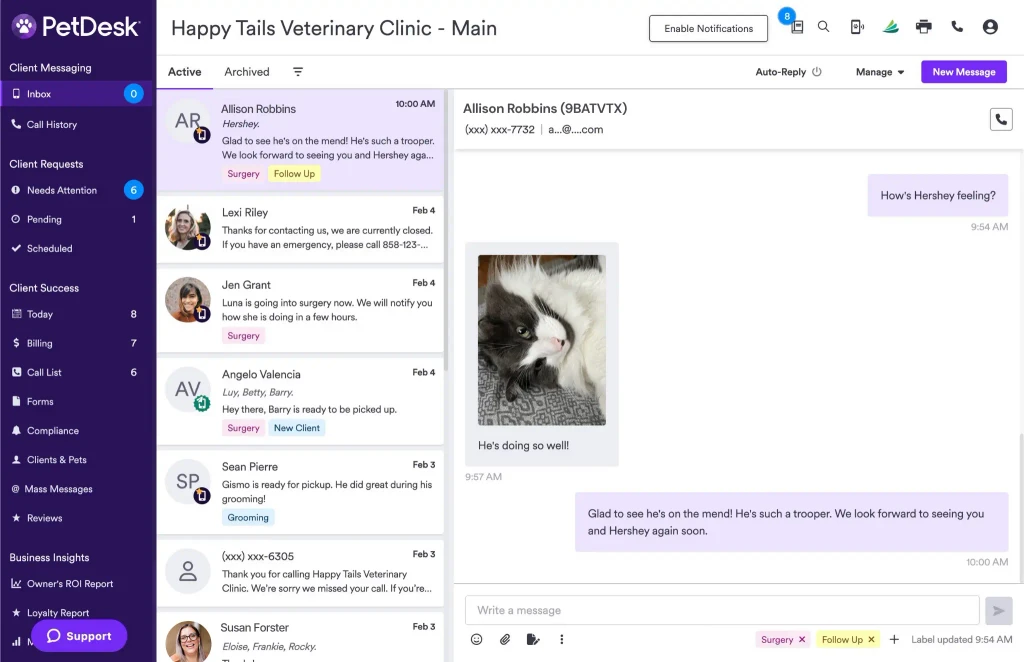
Two-way texting replaces back-and-forth phone calls for routine client communication. Questions get answered from a shared inbox, on your team's timeline, without interrupting the flow of the clinical day.
PetDesk Scribe handles SOAP note documentation and generates visit summaries for pet parents. The time your vets spend on after-hours charting comes back—and so does some of their energy.
True growth isn't about replacing people—it's about protecting them
None of this is about doing more with less. It's about making sure the people you have aren't buried in work that a well-configured system could handle for them.
Research consistently shows that over 75% of veterinary professionals say technology is important to their job satisfaction. Practices with modern tools aren't just more efficient—they're more able to hold onto the people they've invested in training.
Retention is its own form of capacity. A team member who's been with you for three years knows your clients, your systems, and your standards. Replacing that person—if you can find someone at all—costs time, money, and a period of lower-quality care while the new hire gets up to speed.
A different kind of practice growth plan
The conventional model looks like this: hire more staff, handle more volume, grow revenue. When hiring is easy and the labor market is forgiving, that works. Right now, it doesn't.
The alternative: automate routine tasks, free your existing team, and grow without burning out. Instead of waiting for the staffing market to cooperate, build the infrastructure that lets your current team perform at the level of a larger one.
The practices doing this are growing confidently. Not because they solved the staffing shortage—nobody has—but because they stopped letting it be the ceiling on everything they wanted to build.
The capacity you need may already be there, buried under tasks that don't have to be manual anymore.
Modernize your practice with a tech suite that fits your workflow
Your PIMS is your core. PetDesk’s communication and client engagement platform takes your clinic beyond the limits with tools like two-way texting, 24/7 direct booking, PIMS-compatible phones, AI-generated notes, and much more.